Ba Lou Tian Ge (Song of Balou)
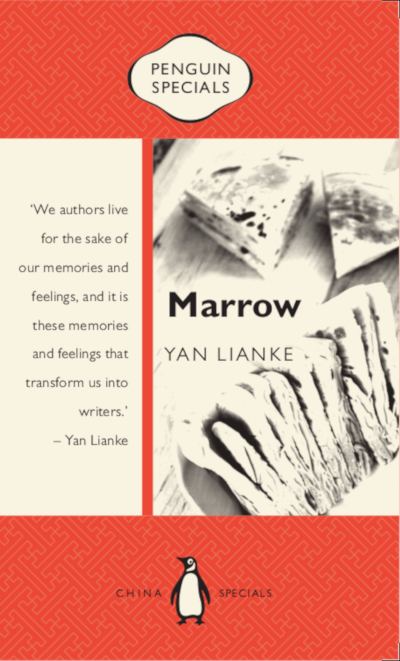
MARROW is a tale of grotesque cannibalism in a small village in the Balou Mountains of China’s Henan Province. In the story, a mother takes extreme measures to provide her four mentally disabled children with a normal life. She feeds them a medicinal soup made from the bones of her dead husband when she finds out that bones ‘the closer from kin the better’ can cure their illness. When she runs out of her husband’s bones, she resorts to a measure that only a mother can take.
‘Yan Lianke creates imaginary wounds in real blood. . . His books read like the brutal folklore history couldn’t bear to remember, and his characters feel stranded, forgotten by time. . . like Beckett’s most memorable characters. . . Desolation has rarely seemed so sensual, so insistently alive. . . Yan’s vulgarity is the flip side of his sensuality, and recalls Upton Sinclair’s line about aiming for his readers’ hearts and hitting them in the stomach.’ New York Times Book Review
‘[Yan’s] characters inhabit a bleak, harsh world. In bitterly hard circumstances, they show courage and ingenuity, defiance and grace. His renderings of real-world desolations are imaginative and wondrous; these austere fables are minimal, but beautifully composed.’ Shelf Awareness
‘Compelling … this work again directs the author’s unflinching gaze on life’s impossible absurdities, exposing a surreal mixture of brutality, openness, even sly humor . . . Provocative.’ Library Journal (starred)
‘Lianke’s talent for the fantastical shines in this collection of two novellas. Though they contain dark subject matter, Lianke’s fables of personal sacrifice are also sharply observed and funny. Lianke’s narratives feel much larger than their page count suggest, almost epic.’ Publisher’s Weekly (starred)
‘Yan Lianke paints vivid scenes of desolate circumstances with an incredible mastery of words and control of his imagery. His masterpieces are sure to engage readers.’ Booklist (starred)
‘A pair of shape-shifting novellas . . . finds the Chinese master at the top of his game. . . Witty, sardonic, and full of rich irony . . . [Yan] Lianke’s pair of works, while set in rural China, offer a golden opportunity to reflect on our own fraught times. His satirical eye and generous heart are finely rendered in Carlos Rojas’ superb translation. These are tales to savour.’ Toronto Star
‘Emotionally loaded stories . . . It’s hard not to be moved by the running theme of self-sacrifice. . . [The Years, Months, Days] pays homage to the fated generation upon whose flesh and bones modern China was built.’ Wall Street Journal (best new fiction)
About Marrow published by itself:
‘Astonishingly good. It is filled with a deep melancholy mixed with a ghostly comedy and a rare sort of narrative energy. Utterly unpredictable and brilliantly weird. A masterpiece.’ Colm Tóibín
‘‘Yan’s novella showcases his hallucinatory imagination and satiric wit.’ BBC
‘This short read is a marvelous addition to the China Specials series, and is a welcome — and quick! — addition to any collection of Chinese literature.’ Asian Review of Books
‘A Chinese soup based on maternal love? Perhaps, but also a fable with high political risk, where Yan Lianke, “the unholy son of realism,” according to his own definition, offers an apocalyptic account of daily life in the Chinese countryside. There, sorghum, superstition, and brutality are cultivated.’ Le Nouvel Obs
‘This little gem delights with its flamboyant prose that magnifies landscapes and gives form to the invisible. But this unusual little text remains profoundly human, authentic, and universal… [Yan] once again shatters literary conventions to our great delight.’ Page des Libraries
‘There’s a Chinese novelist called Yan Lianke, I met him once and we had coffee. I’d read one of his later novels, but if only I’d known he was the author of a short story called Marrow (1998). It’s basically a Chinese folk tale grown into a level of horror, hatred, and pain that is unique. It’s about a woman and her sons, who have various illnesses that are hugely exaggerated, into comic grotesque form. It’s not political, it’s not a metaphor for China. I’d love to have asked him if he’d written it at speed. There really isn’t anything like it by a living writer, that I’m aware of. It’s outstanding. It deals with perspicacity, with pain, with remote places. I think short stories are particularly good at dealing with remote places.’ Colm Toibin in The Spectator
Sales
- Bei’e Art and Literature Press China
- Ryefield Taiwan
- Editions Philippe Picquier France
- Grove Atlantic USA
- Text Australia
- Penguin UK and China (in English)
- Nottetempo Italy
- Sindbad Russia
- Automatica Spain and Latin America
- Arka e Noes Albania
- Epilog Denmark
- Subavi Sri Lanka
Material: Chinese, English, French and more editions