Bogdan-Alexandru Stănescu
French Translation winner of Prix de la traduction Inalco-Vo/Vf
Winner of the Romanian Academy Prize for Literature
Joint winner with Mircea Cărtărescu of the Observator Cultural Prize for fiction
Nominated for the Leibniz Prize for Fiction
Shortlisted for the Romanian PEN Prize
Winner of the Ziarul de Iași Prize
Nominated for the Ficțiunea Prize
Nominated for the Radio România Cultural Prize
Nominated for the Book of the Year Award, awarded by “Romania literară”magazine
‘A metaphysical epic through Romanian history. Stunning’ Telerama
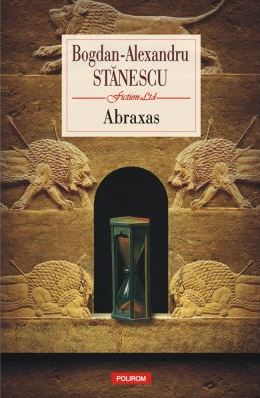
Michi Lucescu is living isolated from people and life in a shabby little rented attic room. He allows himself to be carried by the stream of memory, seeing himself walking along corridors of a typical old communist block of flats. Its landings, covered in green sandstone and tiles, like an indoor swimming pool, bring him to the memory of the strange ‘House with Lions’ where he lived as a small boy with his theatrical and suffocating mother who was a real force of nature. This house like a living creature guarded by two stone lions, was close to the old Jewish cemetery, and from it we see Bucharest during the last decade of communism and the tumultuous year after the Revolution. Interjected are his meanderings through the tower block of memory. Michi opens the doors of its apartments one by one and finds himself in 11 old Bucharest cinemas. He becomes simultaneously spectator and protagonist of 11 films about failure and (self)destruction. These episodes, in which he is playing himself or the parts of strangers, take place in different places and moments of History, from the Dark Ages of Frederick Barbarossa’s failed Crusade to a post-apocalyptical time flooded by ocean waters, passing through Jacob Levy Moreno’s Vienna, Ilarie Voronca’s Paris and Delmore Schwartz’s New York. But all these reflections, some serene, some very dark, come out of Michi’s soul, the soul of Man. They are about life and death, love and the lack of it.
The title ABRAXAS is taken from the book’s motto: “This is a God whom you have not known, for men have forgotten him. We call him Abraxas. He is even more indefinite than God and the devil. (…) He is improbable probability, unreal reality.”. C. G. Jung ,the Red Book Vol VI page 212
‘B.A.S. wrote the first great novel of my generation: Abraxas.’ Marius Chivu, writer, literary critic
‘Already hailed as one of the most important novels in the Romanian contemporary literature, Abraxas by Bogdan-Alexandru Stănescu is made up of a multitude of epic surfaces and tunnels. The book is a veritable narrative labyrinth, a palace of memory transposed to the world of literature through writing full of force and resonance, meticulously crafted stylistically.’ Alexandru Oravițan, Orizont literary magazine
‘I’ll just say that this is one of those moments when I’m sorry I don’t write literary reviews anymore, because if I still did I’d just keep writing for about a month about Bodgan Alexandru Stănescu’s ABRAXAS, about the windings and unwindings of the story, about the suicide of the horse Voronca, about the god Moreno and, alas, about the mass underwater grave that is the post-flood Bucharest in his book. About Michi who declares himself as the author of The Adorable Etruscans (Stănescu’s poetry book). About Princess Ralu, from whose lair, nobody could escape….’ Simone Sora, Romanian novelist, previously literary reviewer, post on facebook
‘Abraxas is a novel that any reader can be fascinated by and be frightened by. Fascination with writing full of intelligence, literary and cultural references, with a monumental and complex construction rarely found in Romanian literature in recent years. And fear, yes, because just like in the story of the sacred theft, about the theft of relics by monks, that Michi Lucescu finds out about from his neighbour Emil ”the Christian”, you know that the mystery is right in front of you, but a part of it will always be unsolved, be somehow beyond you.’ Observator Cultural, recommended books
‘Bogdan Stănescu is one of the most talented writers of the new literary generation in his country. Author of excellent books of poetry, prose and criticism he represents the best of the new post-communist spiritual climate in today’s Eastern Europe.’ Norman Manea, author, multi prize winner, Professor at Bard College
‘With Abraxas, Bogdan-Alexandru Stănescu gave us one of the best Romanian novels of the last decades.’ Mirela Nagâț, in the Apostrof magazine.
‘Bogdan-Alexandru Stănescu has written one of the most beautiful Romanian novels of the last years’ Bogdan Coșa, novelist
‘The most impressive achievement in Romanian literature in recent years. Erudite, baroque in places, fantastic at times, this novel seduces with the immense humanity that pours out from its pages.’ Rasfioala
‘With Abraxas , Bogdan-Alexandru Stănescu offers one of the great books of post-Revolutionary Romanian literature, which will remain as a benchmark for the representation of a complicated period, the years 1990-2000 and all that they meant for the young generation since then’ Observator Cultural
‘One might fear an excess of darkness in Abraxas. But this is not the case. The interweaving of stories, the proliferation of characters, and the art of digression make it a gigantic phantasmagoria.’ Liberation
‘Within the structure of this polyphonic novel, there is a series of reference points that anchor the kaleidoscopic reflections of memory, this magical territory to be explored, allowing the narrative to settle almost organically on the trunk of the evocation: the block of flats on Trestiana Street, containing eleven apartments, and behind each of its doors, a cinema where crucial moments of life are projected, like so many chapters composing this book. And even if these eleven cinemas are not quite as identical as the rooms in Borges’s Library of Babel, the idea of a universal mirror reflecting humankind in all its diversity and fragile condition prevails, also validating the idea of the Portuguese writer Pessoa who tells us that “literature is proof that life is not enough.”’ Lettres Capitales France
‘The writing, dense and sinuous, follows the flow of memory to the point of producing a veritable sensory choreography… The author excels at capturing the coexistence of the trivial and the mythical… Stănescu blends autobiography, subtle hallucination, and meticulous documentary detail. His rich, metaphorical prose unfolds a haunted memory that questions family legacy, the transmission of fear, and the persistence of the past. Abraxas offers a narrative of lyrical gravity, where the truth of childhood carves its way through the density of the language and the inexorable return of ghosts.’ Actualitté
‘Isolated from the world, in the attic of an old house, Mihai Lucescu, hero of Abraxas, delves into memories of his childhood, amid the apocalyptic tensions of his broken family, between a painter mother with a volatile personality and a fickle, psychologically rigid father. Nicknamed Kitz-Kitz, the man spent his adolescence in Bucharest during the last decade of communism, between the matchbox-sized apartment in a building from the Ceausescu era, where his paternal grandparents lived, and his mother’s house, next to the Jewish cemetery. Guarded by two stone lions and adorned with a stained-glass rose window, the building is a voracious matrix. The architecture of the place subtly communicates with the architecture of his memory as the character, carried by a kind of dreamlike amnesia, penetrates deeply ‘into the heart of darkness’, revealing scenes from his own life but also the destinies and figures of other spaces and historical eras. During his wanderings through the scaffolding of his memories, Michi opens, one after the other, the doors of the ‘cinema’, becoming both spectator and protagonist of a film about the decline of things and beings, governed by ‘that overwhelming loneliness that weighs on your guts like a lump of krill in the belly of an old whale’. Taking us from the Vienne of psycho-sociologist Iacov Levi Moreno to the Paris of poet Ilarie Voronca, as well as to New York with writer Delmore Schwartz – all three of Romanian origin – the novel turns out to be a spectacular theatre of shadows, meticulously cut out, as in an engraving by Albrecht Dürer. An ambiguous interweaving of light and darkness, mirroring the personality of the god Abraxas, Bogdan-Alexandru Stânescu’s novel has the ingenuity of retelling the history of the melancholy of the world in a language rich in visual and sensory imagery.’ Revue des Deux Mondes
Sales
- Polirom Romania
- Cigoja Serbia
- Antolog Macedonia
- Gallimard France (Du Monde Entier)
- Noir sur Blanc Poland
- Janet45 Bulgaria
Material: finished copies of Romanian edition (600pp), French and English sample translations